


 Shopping cart


Viking knive reproductions for authentic medieval and Viking Age Re-enactment
Replicas of Viking knives based on historical models of the early Middle Ages.Continue ...
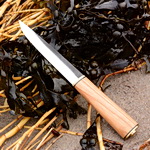 In our medieval shop you can buy true-to-detail Viking knives, forged by hand in various designs and perfectly suited for authentic Viking re-enactment. These solidly crafted replicas of Viking knives were modelled on historical finds from Birka, Gotland and Heddeby. Our Viking knives are provided with wooden handles and handle parts made of real horn and bone and with hand-forged blades of carbon steel or multi-layer damascus steel. All of our Viking knives are equipped with solid leather sheaths, some of them with bronze or brass fittings.
Continue ...
Retailers for LARP or medieval re-enactment are welcome to register for our medieval wholesale store.
Products
show 1 to 12 (out of a total of 12 articles)
Dealers for museum supplies, medieval and Viking re-enactment or LARP are cordially invited to register as retailer for wholesale in Pera Peri's medieval shop. We guarantee the best quality at good prices with short delivery times!
Interesting facts about Viking knives
 The Viking knives in the Pera Peris range – House of History
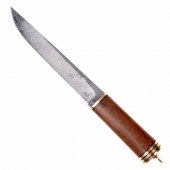 At Pera Peris' Medieval Mail Order, you can buy detailed replicas of Viking knives with hand-forged blades based on historical models and carefully crafted handles. We also stock Viking-era saxes in our range.
Our replicas of Viking knives are based, among other things, on models of Viking-era finds from excavations in Yorvik, Haithabu, Birka and Gotland, and, like the historical originals, have wooden handles and handle parts made of brass, horn or bone.
The blades for our Viking knives are made from high-quality carbon steel or multi-layered Damascus steel.
All our Viking knives come with a sturdy sheath made from high-quality, purely vegetable-tanned leather, some of which may also be fitted with authentic bronze or brass edge fittings.
We offer bronze handle parts, strap distributors and detailed sheath fittings based on Viking-era models, as well as replicas of ort bands and mouth plates for Viking saxes.
In addition to complete Viking knives, you can also purchase individual knife blades based on Viking and medieval models in our medieval shop, or purchase entire knife kits and make your own Viking knife according to your own ideas.
 The different types of Viking knives
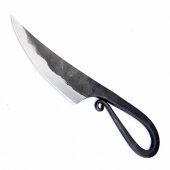 A type of knife often referred to as a Viking knife or women's knife of the Vikings is forged from a single piece of steel. Instead of a handle made of organic material, it has an elegantly curved and sometimes twisted handle and looks beautiful and filigree – but unfortunately, as pretty as this knife is, it is not a Viking knife.
This type of knife dates back around 1000 years before the Viking Age and belongs to the Roman Iron Age.
The earliest finds from the northern countries come from graves in Denmark, where the knives have been preserved in remarkably good condition due to the bog-like soil and its oxygen-poor environment.
Viking knives, on the other hand, always had handles made of organic material and were never forged from a single piece.
Excavations in Haithabu, Birka and Oseberg, as well as in Gotland and the Baltic States, and finds in Belarus and Ukraine have revealed a whole range of Viking-era knife types.
The basic shape of a Viking knife is roughly the same as that of today's Scandinavian knives or Finnish puukkos, although Viking knives usually had a straight or indented handle.
The blade of Viking knives had a flat V-shaped cross-section and could have either a sharp or blunt tip, with a very strong spine that was rarely less than 5 mm thick and could even be up to 12 mm thick on large knives or saxes.
 The handle of a Viking knife
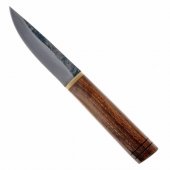 During the Viking Age, knives with a tang were particularly common, in which the blade ended in a pointed tang, also known as a spine, which usually tapered to a point at the end, making it easier to ‘burn in’.
During the burning process, the tang was heated in a fire and hammered into the pre-drilled handle, using a mixture of pitch, wax and resin as an adhesive to securely bond the blade to the handle. Wood is particularly suitable as a handle material, which is why it is most commonly found in archaeological finds, but bone has also been found in Viking knives.
In Haithabu alone, 78 Viking knives with handles made of stone fruit wood were found. However, ash wood was most commonly used for the Viking knives from Haithabu. The knives from Haithabu were all simple working knives that had certainly been used in the household, crafts and kitchen.
In addition to classic Viking-era knife blades, of which 119 examples in more or less pointed designs were found in Haithabu, the find material also included 66 finds with a Bowie knife-like blade and 83 artefacts with a somewhat unusual, blunt tip, reminiscent of a bread knife in shape.
In addition to Viking knives with a tang, knives with a so-called handle tang were also used in the Viking Age, in which the tang was inserted through a hole along the entire length of the handle and simply bent over or solidly riveted at the end.
With this design, small discs made of bronze, tin or iron could be inserted at both ends and in the handle itself. Several metal plates for knife handles were found in Haithabu. Fittings made of bronze sheet metal or wrapped with bronze wire were also common.
Three-dimensional decorations were rather unusual on Viking knives, but did occur in isolated cases. Simple, two-dimensional handle decorations, on the other hand, were more widespread and mostly designed as linear and geometric patterns.
Braided bands, wave bands and ring chains were common as decorations, especially on West Slavic knives. Circular eye decorations were also widespread as decorations on knife handles, also known as dot eye patterns or compass strokes.
 The Viking knives of Gotland
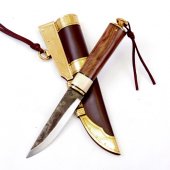 Particularly striking are the Viking-era knives from Birka, Gotland and the Baltic region, which were fitted with elaborate sheaths made of bronze-studded leather, decorated with punched elements and chased patterns.
Behind the actual bronze sheath fitting, these Viking knives sometimes also had a second fitting made of copper, which contrasted with the openings in the former. The ends of the handles of Gotland Viking knives could also be covered with brass sheet metal.
In addition to the elaborately designed knife sheaths, knives with simple, undecorated sheaths were also used on Gotland and in the Baltic States, as in all areas settled by Vikings, for which goatskin was often used.
However, a typical feature of Viking knives from Gotland was a ring attached to the end of the knife handle, which was used to pull the knife out of the sheath, as they were inserted very deeply into the sheath to prevent the knife from being lost.
These Viking knives were often attached with a chain to a belt distributor ring that connected two parts of the belt.
As was customary in the Viking Age, most Viking knives from Gotland were made of fairly soft iron with a steel cutting edge laminated onto the back of the blade and had a V-shaped blade cross-section with a fairly wide back, which could be up to 8-12 mm.
 Knife blades in the Viking Age
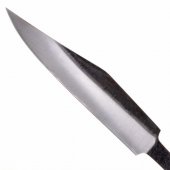 During the Viking Age, knife blades were almost exclusively made of so-called welded composite steel, which consisted of hard steel and soft steel or iron.
Unlike modern knives, which are usually made from a single piece of steel, Viking knives were generally made from several layers.
The blades often had only low rigidity, as large parts of the blade often remained unhardened. This meant that the blades were easily deformable and could be bent with little effort.
For this reason, Viking knives usually had blades with a spine thickness of well over 5 mm up to 12 mm and a V-shaped angle, which is still typical of Scandinavian knives today and significantly improved the rigidity of the blade.
The blades of Viking knives were often made of two layers of steel welded together perpendicularly, with the hard steel serving as the cutting edge, which was important for sharpness and durability, while the soft steel, or even simple iron, served as the back, where elasticity was particularly important to prevent the blade from breaking.
In addition to horizontal welding, the two parts could also be welded together at an angle.
There were also Viking knives in which the hard steel for the cutting edge was sandwiched between two or more layers of soft steel or iron, which were welded together to form a multi-layer steel.
Similarly, softer material could be bent around a core of hard steel and welded, or conversely, hard steel could be folded around a soft core. Knife blades made entirely from a single piece of refined steel remained the exception, as saving materials was probably much more important in the Viking Age than the amount of work involved.
 The folding knives of the Vikings
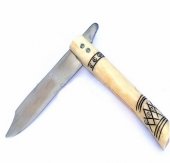 The Romans were already familiar with folding knives. So it is not surprising that they were still widespread in the Viking Age. There are a number of finds of Viking-era folding knives.
Like today's folding knives, Viking folding knives were rather small and handy and could be safely stored in a pocket on a belt. Since folding knives have been found in almost all areas settled by Vikings, they were probably a commonly used tool for everyday work.
A particularly beautiful example is a Viking folding knife from Canterbury, England, which had side jaws made of bone that were richly carved with elaborate ring motifs.
But folding knives from the Viking Age have also been found in Birka (Sweden), Dorestad (Netherlands), Mardi (Latvia), Mikulcic (Czechia), Gniezno (Poland) and Novgorod (Russia), with the latter even having bolsters made of non-ferrous metal, whereas other folding knives had bolsters made of wood or antler.
 What other types of knives can you buy at Pera Peris?
We hope you enjoyed this little excursion into the world of knives from the Viking Age, and that you will find a Viking knife to suit your taste for everyday use or historical re-enactment in our medieval shop.
In addition to Viking knives, you can also buy other types of knives in other categories of our medieval shop.
In the category Iron Age knives, you will find forged knives made by hand from a single piece of metal, based on models from the Celtic and Germanic Iron Age.
In the category Early Medieval Knives, you will find a selection of early medieval knives with simple wooden handles and leather sheaths.
Under Medieval Knives, we offer a fine selection of replicas of late medieval knives with elegant, slender handles made of horn, bone or wood and fine, embossed leather sheaths.
Classic and timelessly beautiful knives with blades made of carbon steel or fine Damascus steel with sturdy leather sheaths can be found in the Hunting Knives category.
If you don't want a ready-made knife, you can of course simply buy a knife blade or sax blade and build your own knife using the handle materials we offer. We also offer complete knife kits for this purpose, including knife blade, handle material, leather sheath and assembly instructions.


