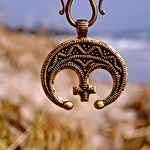
Slavic Amulet Replicas of the Viking Age in Bronze and Silver Plated

Here you can buy detailed replicas of Slavic amulets and pendants of the Viking Age.Continue ...

Buy Slavic amulets Here you can buy authentic replicas of Slavic pendants based on historical finds from the Viking Age, made of bronze or in real silver, perfect for your historical clothing. We offer Slavic disc amulets with filigree granulation decoration, true to detail replicas of crucifixes and cross pendants from the Viking Age, typical Lunula or Lunitsa charms and many other amulets. These replicas of Rus and Slavic pendants are a noble addition to authentic Viking and medieval re-enactment and are equally suitable as ambitious jewellery for everyday life.

Slavic amulets as witnesses to a turbulent era

Slavic amulets and pendants from the Viking Age, as documented in the Kievan Rus region and among the Western Slavs, offer a fascinating insight into a world where Eastern and Northern influences converged. When we look at these Slavic necklaces, such as the moon-shaped lunula amulets or the distinctive tryzub pendants, we see the connection between local tradition and supra-regional trade.

Slavic necklaces from the Viking Age are an expression of deeply rooted symbolism that gave the people of the Middle Ages a sense of protection and belonging. Our detailed replicas allow you to bring historical continuity back to life in your portrayal or everyday life. We have closely followed authentic models in our reconstruction to offer you a historically accurate experience, crafted from high-quality jewellery bronze, genuine silver-plated or 925 sterling silver.

Slavic symbolism: lunula, tryzub and kolovrat

The lunula amulet, which came in various sizes and designs, as shown by finds from Gnezdovo and Great Moravia, is considered a classic symbol of fertility and female power. In contrast to this are the Tryzub pendants, reminiscent of stylised falcons, which, as symbols of the Rurikid dynasty's rule, refer to the political power claims and identity of the Rus.

The Slavic Kolovrat amulet, with its striking sun wheel motif, draws on mythological ideas of Slavic paganism. Each of these forms, from simple crosses to the ornate Svantevit pendant from Wolin, is reproduced by us with a high degree of care in bronze or silver. You thus receive authentic testimonies to a jewellery culture that is both aesthetically and historically profound.

Craftsmanship: granulation and filigree work

What distinguishes Slavic pendants and amulets is their craftsmanship, especially in granulation and filigree decoration. The diverse granulated amulets of the Vikings, found in Birka or on Gotland, for example, reveal the high technical skill of the Slavic goldsmiths of the time and the significant trade activities between Slavs and Vikings.

In our replicas, we strive to bring the craftsmanship of Slavic artistry back to life. Whether it is the Rus cross or the fine ornaments on the moon pendants, craftsmanship and detailed reconstruction are the keys to authenticity for us. When you wear these pieces, you can feel the care and technological mastery that characterised Slavic jewellery craftsmanship.

Cultural networks: bridges between Rus, the West and the East

The diversity of our Slavic pendants and amulets reflects the connection between the Slavic and Scandinavian worlds in the early Middle Ages. These remarkable pieces of jewellery prove that the world of the Viking Age was by no means closed in on itself, but was characterised by lively exchange.

We see it as our task to preserve these bridges through our detailed replicas. For anyone interested in the material culture of the Slavs and Rus, our selection is an invitation to delve deeper into the connections of this vibrant cultural exchange. We offer you much more than just jewellery – we offer you an authentically designed window into the history of a Europe that was already interconnected at that time.

Show less

Retailers for LARP or medieval re-enactment are welcome to register for our medieval wholesale store.

Products
show 1 to 21 (out of a total of 21 articles)
Kolovrat-Amulet - silver
0 Kolovrat Eight-spoked Kolovrat amulet, the Slavic sun wheel in the shape of a medieval shield. Bronze, silver-plated or 925 silver. 3 cm diameter.
Details
2-3 Days Status:2-3 Days
Quick Order
from 10,92 €* 2-3 Days
Svantevit-Amulet - bronze
0 Svantevit Svantovit amulet. Slavic pendant from the Viking Age after a find from Wolin. Bronze, silver-plated or 925 silver. 5.8 x 0.8 cm.
Details
2-3 Days Status:2-3 Days
Quick Order
from 18,48 €* 2-3 Days
Filigree disc pendant - silver
0 Filiigran 1 Viking pendant with Slavic granulation decoration according to an original model from Birka. Bronze, silver-plated or 925 silver. 2.5 x 1.9 cm.
Details
2-3 Days Status:2-3 Days
Quick Order
from 5,87 €* 2-3 Days
Granulation pendant - silver
0 Filiigran 2 Pendant replica with Slavic granulation decoration according to a historical model from the Viking Age. Bronze, silver-plated or 925 silver. 3 x 2.5...
Details
2-3 Days Status:2-3 Days
Quick Order
from 7,55 €* 2-3 Days
Granulation disc amulet - bronze
0 Filiigran 3 Viking amulet with granulation decoration after a model from Stora Ryk on Gotland (Sweden). Bronze, silver-plated or 925 silver. 3.6 x 3 cm.
Details
2-3 Days Status:2-3 Days
Quick Order
from 10,08 €* 2-3 Days
Rus Viking cross pendant - bronze
0 Rus-Cross Rus Cross from Gotland. Replica of a historical cross pendant of the late Viking Age. Bronze, silver-plated or 925 silver. 4 x 4 cm.
Details
2-3 Days Status:2-3 Days
Quick Order
from 8,40 €* 2-3 Days
Cross lunitsa replica - bronze
0 Lunula C Lunula / Lunitsa amulet with cross. Slavic half moon pendant of the Viking Age from the Kievan Rus. Bronze, silver-plated or 925 silver. 3.5 x 35 cm.
Details
2-3 Days Status:2-3 Days
Quick Order
from 10,08 €* 2-3 Days
Small lunula amulet - silver
0 Lunula AA Tiny Lunula charm. Slavic half moon pendant replica after from Great Moravia. Bronze, silver-plated or 925 silver. 2.5 x 2 cm.
Details
2-3 Days Status:2-3 Days
Quick Order
from 5,03 €* 2-3 Days
Rus lunula pendant - bronze
0 Lunula A Small Lunula Pendant. Slavonic moon charm of the Viking Age from the territory of the Kievan Rus. Bronze, silver-plated or 925 silver. 3 x 4 cm.
Details
2-3 Days Status:2-3 Days
Quick Order
from 6,71 €* 2-3 Days
Lunula amulet - bronze
0 Lunula Morava Lunula amulet of the Viking era. Detailed replica of a Slavic crescent pendant from Great Morava. Bronze, silver-plated or 925 silver. 3 x 4 cm
Details
2-3 Days Status:2-3 Days
Quick Order
from 10,08 €* 2-3 Days
LArge Lunula amulet - silver
0 Lunula B Large lunula amulet. Slavonic moon pendant of the Viking Age from the area of the Kievan Rus. Bronze, silver-plated or 925 silver. 4.5 x 3.5 cm.
Details
2-3 Days Status:2-3 Days
Quick Order
from 11,76 €* 2-3 Days
Slavonic lunula amulet - bronze
0 Lunula D Extra large Lunula pendant. Slavic moon amulet of the Viking Age from Gnezdovo / Ukraine. Bronze, silver-plated or 925 silver. 4.5 x 3.5 cm.
Details
2-3 Days Status:2-3 Days
Quick Order
from 23,52 €* 2-3 Days
Rus Tryzub-Tamga - bronze
0 FCK-PTN FCK PTN Tamga - Ruling sign of the Rurikid Dynasty under St. Vladimir I from the 10th century. Bronze, silver-plated or 925 silver. 3.5 x 1.9 cm.
Details
2-3 Days Status:2-3 Days
Quick Order
from 10,08 €* 2-3 Days
Ukrainian Trident charm - bronze
0 Dreizack Tryzub pendant of the 11th Century, a so-called Rurikid trident after a medieval tamga of the Rus. Bronze, silver-plated or 925 silver. 3.3 x 1.7 cm.
Details
2-3 Days Status:2-3 Days
Quick Order
from 6,71 €* 2-3 Days
Rus Tryzub pendant - bronze
0 Med-Tryz Tryzub pendant from the 11th century based on the so-called Rurikid trident of an early medieval tamga. Bronze, silver-plated or 925 silver. 3.3 x 1.7...
Details
2-3 Days Status:2-3 Days
Quick Order
from 6,71 €* 2-3 Days
Ukrainian Falcon - Bronze
0 Falke - KL Falcon Amulet - The Tryzub of Ukraine in the shape of a falcon. Bronze, silver-plated or 925 silver. 3 x 2 cm. A donation for the Emergency Aid...
Details
2-3 Days Status:2-3 Days
Quick Order
from 8,40 €* 2-3 Days
Ukrainian Falcon-Pendant
0 Falke - GR Tryzub Falcon - The Ukrainian trident in the shape of a flying falcon. Bronze, silver-plated or 925 silver. 4.2 x 2.8 cm. A donation for Emergency...
Details
2-3 Days Status:2-3 Days
Quick Order
from 10,08 €* 2-3 Days
Ukrainian Falcon Set
0 Falke - SET Jewellery set with pendant and earrings in the shape of flying falcons. Bronze, silver-plated or 925 silver. A donation for Emergency Relief Ukraine!
Details
2-3 Days Status:2-3 Days
Quick Order
from 25,20 €* 2-3 Days
Viking hammer axe pendant - bronze
0 Axt Hammer Viking hammer axe pendant. Amulet according to historical models of the Slavs and Rus. With leather cord. Bronze, silver-plated or 925 silver. 4 x 2...
Details
2-3 Days Status:2-3 Days
Quick Order
from 8,40 €* 2-3 Days
Axe of Perun - bronze
0 Axt Perun Replica of the Axe of Perun" / hatchet amulet connected with the Slavic god Perun after a Viking find. Bronze, silver-plated or 925 silver. 4 x...
Details
2-3 Days Status:2-3 Days
Quick Order
from 14,28 €* 2-3 Days
Axe pendant of Perun - silver
0 Axt Makarov Axe of Perun. Miniature axe amulet of the western Slaves and Rus after a find of the late Viking age. Bronze, silver-plated or 925 silver. 4.5 x 3.3...
Details
2-3 Days Status:2-3 Days
Quick Order
from 15,12 €* 2-3 Days
Dealers for museum supplies, medieval and Viking re-enactment or LARP are cordially invited to register as retailer for wholesale in Pera Peri's medieval shop. We guarantee the best quality at good prices with short delivery times!

Pendants of the Slavs in the Viking Age

The Slavic jewellery: cultural bridges and archaeological horizons

Slavic amulets and pendants from the Viking Age are much more than mere decorative elements; they are material evidence of a highly complex era in which trade routes and cultural influences extended across the entire Baltic Sea region, the Black Sea and deep into the Orient. The jewellery art of this period, documented by many finds between the Elbe and Oder rivers, shows a remarkable fusion of local traditions with Nordic, Byzantine and Oriental stylistic elements.

In particular, the silver hoards of the late Slavic period, such as the treasure trove found in Schwaan or the magnificent deposits from the Volga region, testify to the enormous wealth of hack silver and magnificent jewellery that found its way into Slavic settlement areas through long-distance trade. Replicas of these finds allow us to rediscover the significance of these Slavic pendants and protective amulets as symbols of identity and spiritual companions.

Regional divergences: Western and Eastern Slavic forms

A look at the archaeological finds reveals significant differences between the Western and Eastern Slavic tribal groups. While the East Slavic Rus principalities showed a strong affinity for massive silver work and magnificent pearl necklaces, the West Slavic region – the area of today's Poland, Czechia and eastern Germany – is characterised by a more filigree design language.

In contrast, the Slavs in the east often favoured so-called axe amulets. These small axe-shaped objects, often cast in bronze and decorated with circular eyes, are usually interpreted by researchers as attributes of the thunder god Perun. They are often found in men's graves and point to a warlike symbolism that was closely linked to the social hierarchy of early Rus society. This regional variance illustrates that Slavic jewellery was not a monolithic phenomenon, but rather a reflection of local power structures and beliefs.

Lunula, Kolovrat and Kaptorgas: myth and protective magic

The symbolism of Slavic amulets is deeply rooted in early historical beliefs. The lunula amulet (lunniza), for example, a crescent-shaped pendant, is found in numerous variations throughout the Slavic settlement area. While it originally dates back to Roman influences as a symbol of the goddess Luna, it developed into one of the most distinctive pieces of jewellery among the Slavs in the 10th century. Archaeological analyses of grave goods indicate that these pendants were often worn on necklaces in combination with glass beads, corals and temple rings. Research often interprets it as a symbol of protection for women and fertility, serving to protect unborn life.

In contrast to this is the Kolovrat, which literally means spinning wheel. A sun wheel motif with usually eight rays, it is understood as a sign of the eternal cycle of nature and stands for the sun, fire, life cycles and symbolically for the god Svarog. Nowadays, it is also popular as a pendant worn around the neck.

So-called kaptorgas, small rectangular or trapezoidal containers, were decorated with animal or plant motifs and were proven to contain protective substances, medicinal herbs or, in the Christian context, later relics. Finds from the Gniezno area show that Slavic kaptorgas were often elaborately decorated with niello inlays, indicating the high social status of their owners. These objects illustrate how the Slavic world interpreted natural phenomena spiritually and manifested them in their everyday need for protection.

Sacred animal world: horse and bird amulets

An often overlooked aspect of Slavic miniature art is animal-shaped pendants. The horse occupied a prominent position in Slavic mythology. Historical sources, such as reports about the sanctuary of Swantevit in Arkona, describe the horse as an oracle animal. Small bronze horse pendants, which are particularly common in the Baltic-Slavic contact area, symbolise strength, endurance and the connection to the divine sphere.

Small amulets with bird motifs, especially birds of prey or ducks, are also common. While the falcon was often associated with heroism and the warrior elite, duck pendants are frequently found in female burials. Research suggests that water birds played a role as creators of the world in Slavic cosmogony. These zoomorphic representations testify to a deep connection to nature and an animistic worldview that persisted in folk art and jewellery even after official Christianisation.

Technological mastery: filigree granulation

An essential aspect of Slavic metalwork is its technical complexity, particularly the use of granulation and filigree work. These techniques were often inspired by Byzantine models, but were further developed independently by Slavic craftsmen. Finds from the magnificent tombs of Mikulčice and trading centres such as Krakow show that the goldsmiths of that time had a deep understanding of metallurgical processes. The application of tiny metal beads or the laying of the finest wires required a precision that underlined the social status of the person wearing the jewellery.

In addition to these precious metal works, bronze casting using the lost wax process was widespread. This allowed the production of mass-produced goods for the rural population that were nevertheless aesthetically sophisticated. When we produce these Slavic pendants as detailed replicas, we strive to preserve this appearance in bronze and silver. We take care to preserve the surface structure and feel of the original finds. However, these pieces of jewellery are not only important for re-enactment, but can also serve as symbolic windows to the past when worn as necklaces in everyday life.

History to wear: a window to the past

Researching Slavic jewellery replicas always involves examining the history of global exchange in the Middle Ages. The presence of Oriental dirhams, which were often pierced by Vikings and Slavs and worn as pendants, as well as Nordic knot patterns in Slavic finds, shows that the medieval world was by no means static. The Slavs acted as a crucial link between the Scandinavian markets and the opulent cultures of the south and east.

We see our work as a contribution to the preservation of this cultural heritage. For us, an authentic replica is the key to understanding the material culture of that time. We are not only concerned with reproducing a form, but also with understanding the craftsmanship and ideas behind it. By preserving and replicating these pieces of jewellery, we are helping to make knowledge about the social, religious and technological contexts of early Slavic history accessible to the present day.


Your advantages

  • Large selection
  • Availability display
  • tracking
  • Smart shop navigation
  • Friendly customer service

Safe shopping

  • 14 days right of withdrawal
  • Over 25 years experience
  • Fast money back
  • Good returns management
  • Professional order processing

Customer service

Tue | Thu | Fr | from 10-12 and 13-15
phone+49 (0)3504-625 85 15

Payment methods

PayPal Mastercard Visa Vorkasse / Moneyorder

Shipping methods

DPD DHL UPS

Social media

facebooktwitterpinterestinstagram
*All prices incl. VAT, incl. packaging costs, plus Shipping costs plus any customs duties (for non-EU countries). Crossed out prices correspond to the previous price at peraperis.com.
© 2026 Pera Peris - Haus der Historie
Go to mobile site